


When the Amani Kibera Book House opened in Lindi Village, Kibera, more than 60 children queued outside to enter. Among them was Precious, who had walked for more than an hour to visit the new library.
Professor Peter W. Ferretto, Director of the School of Architecture at The Chinese University of Hong Kong (CUHK), welcomed him inside. The two read a story together. Afterwards, Precious drew a picture for the professor, a gesture that Professor Ferretto still treasures.

The moment captures what the project set out to achieve: not simply a building, but a form of social infrastructure shaped by the people it serves.
Designed by Condition_Lab, a design-research laboratory founded by Professor Ferretto and three of his PhD students, Milly Lam, Paula Liu and Ling Pak-wai, in 2018, the Book House provides space for reading, learning, skills training and community activities. For Condition_Lab, the project represents an approach known as “slow architecture”. Rather than imposing a predetermined architectural style, the process begins with close observation, extended dialogue and collaboration with local partners and residents. “Architecture is most impactful when it emerges from the place, shaped by the needs and voices of its users.” Professor Ferretto says.
Designing through listening
The project began in 2022, following Condition_Lab’s engagement with UN-Habitat in Nairobi, Kenya. The team subsequently partnered with Kounkuey Design Initiative (KDI), an organisation recognised for its work in Kibera and other informal settlements. Together with KDI, Condition_Lab engaged with ten neighbouring communities before selecting Amani Kibera as its community partner, whose experience in empowering local women and young people was an important consideration.
From the outset, the project was conceived as a collaboration rather than a conventional commission delivered by architects to a community. “The project was not about architectural authorship, but about building ‘with’, not ‘for’, the community,” Professor Ferretto says.
Residents participated in design workshops with village elders and children. Their feedback helped shape the building’s open layout, facilities and relationship with the surrounding public space. Local labour and materials were used throughout construction, reinforcing the connection between the design process and the community’s own knowledge and capabilities.
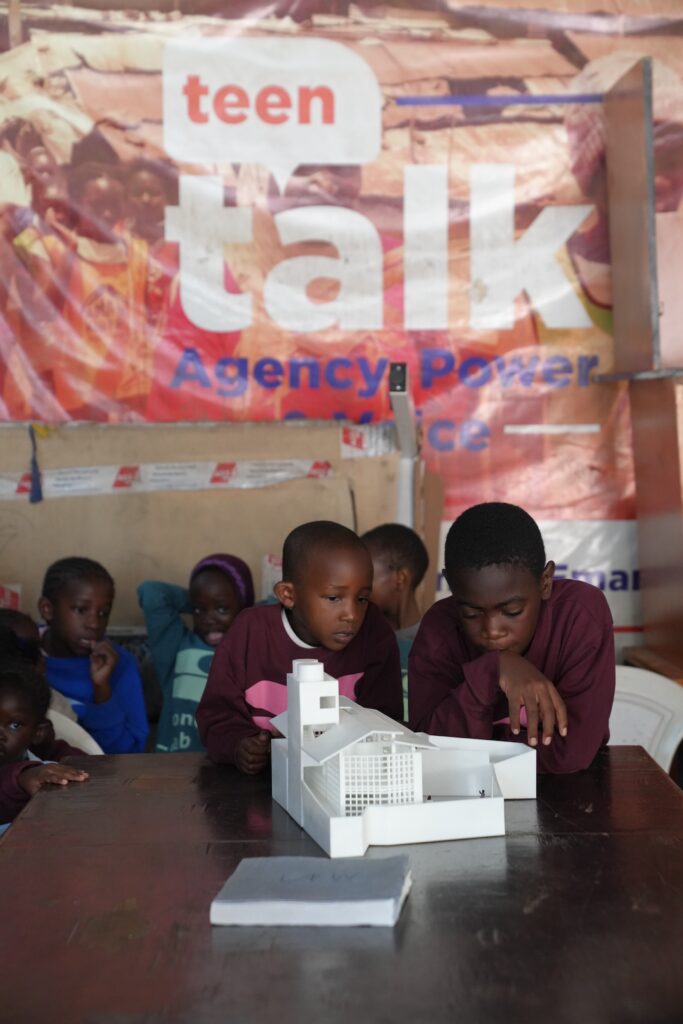
For Condition_Lab, this is the distinction between consultation and co-design. Participation is not limited to asking residents for their opinions after key decisions have been made. It requires designers to listen, adapt their proposals and amplify community agency.
The approach reflects the laboratory’s broader philosophy: to explore how design can serve communities that are often unable to access professional architectural services. Working across research, teaching and practice, Condition_Lab adapts its process to different social and geographical contexts rather than exporting a uniform architectural style.
A library and public square
The decision to create a book house was rooted in the needs of children, young people and women in Lindi Village. The community is home to many Nubian families and faces challenges including limited access to running water, poor sanitation and inadequate infrastructure. At the same time, Professor Ferretto describes the community as having a strong culture and deep social bonds.
The building was therefore designed not merely as a library, but as an anchor for communal life. Its ground-floor façade can be fully opened, allowing the interior to connect with the space outside. Natural light and an open layout create a welcoming environment for reading, while enabling the building to accommodate larger gatherings, markets, dances and festivals.
In a community where public spaces are limited, the Book House provides a shared venue for activities that bring residents together. Its facilities also support everyday dignity, including toilets, showers, a kitchen, a prayer room and a ramp for universal access. The workshop space extends the building’s role beyond education, enabling women connected with the Amani Kibera Fashion School to receive training and develop practical skills linked to livelihood opportunities.
The value of a slower process
Participatory design can be demanding. In Kibera, the team faced financial uncertainty, construction complications and the practical challenges of delivering a project in a location that few outsiders visit. Sustaining a collaborative process also required continuous dialogue among different groups and careful attention to ensure that no single interest dominated the project.
These challenges are part of what Condition_Lab means by “slow architecture”. The term refers not simply to a longer construction period, but to a deliberate way of working: spending time on site, understanding local conditions and allowing the design to develop through dialogue. “We are disciplined about resisting a one-size-fits-all style or exporting a predetermined ‘look’,” Professor Ferretto says. “Instead, we have refined a participatory process, what we call ‘slow architecture’.”
The process has also changed the researchers and students involved. Professor Ferretto says the team learned from the community’s resilience in conditions of scarcity and from the strength of its social relationships. Their role, he adds, came to be understood less as that of external experts and more as stewards and supporters.
For Condition_Lab, the longer-term value of such projects lies in the social infrastructure they help develop: local leadership, more equitable access to services and improvements in everyday life.
From CUHK to the world
The Amani Kibera Book House illustrates how CUHK research can connect academic inquiry with practical challenges beyond the University campus. Condition_Lab was established with support from CUHK’s Sustainable Knowledge Transfer Project Fund.
“CUHK’s ongoing support, through its research funding, openness to interdisciplinary work, and nurturing of student involvement, has allowed us to stay true to our ethos and expand our impact globally,” Professor Ferretto says. “This model shows how academia can catalyse new forms of architectural practice: ones that prioritise people, generate collective responsibility, and set a benchmark for the profession worldwide.”
Many of its projects also contribute to doctoral research, embedding learning in real-world contexts. This approach brings together architectural practice, research and education, while enabling students to consider how design decisions affect communities in different parts of the world.
For CUHK, the project demonstrates internationalisation as an exchange of knowledge rather than the export of a fixed solution. A methodology developed by a Hong Kong-based research team must be re-examined and adapted when it encounters the history, culture, needs and aspirations of a community in Africa.
That process of adaptation is central to the School of Architecture’s educational philosophy. Professor Ferretto describes the School as founded on the interrelationship between practice and teaching: “To teach architecture is to practise architecture, to practise architecture is to teach architecture.”
The Book House is therefore both a community facility and a research outcome. Its significance lies not in offering a universal model for informal settlements, but in showing how architecture can begin with local knowledge and develop through shared responsibility.
For the children who read there, the women who receive training there and the residents who gather there, the building has become part of daily life. For CUHK’s researchers and students, it offers a continuing lesson in what socially sustainable design requires: patience, humility and the willingness to build with communities rather than for them.